
Current location – ‘The new normal’
Along with “unprecedented times” and “you’re on mute” one of the most used phrases over the last 12 months has to be – “the new normal.”
But what exactly is the ‘new normal’? More importantly, what does it mean in practical terms? And what does it mean for marketing?
In the Wizard of Oz after that stormy tornado, things looked different. For marketers and businesses, Dorothy’s situation is relatable. The landscape has changed – but what has changed permanently, and what will go back to pre-pandemic times? The answers will impact future marketing strategies. So, amidst all this change, what should marketers focus on and invest in?
This blog explores areas of digital marketing that may have changed forever, as a result of Covid-19.
In broad terms, because of the pandemic, we’ve accelerated digitally by around 8-10 years. Those Zoom exercise classes probably would have become popular but in 2029 – rather than now. A study by McKinsey & Co says that “We have covered ‘a decade in days’ when it comes to the adoption of digital.” Amongst the many changes, what’s noteworthy for digital marketers? Here are our thoughts.
Online content – Bigger, better & smarter
Lockdowns meant that in-person meetings weren’t possible. And with many of us spending 23 hours a day at home, internet use for entertainment increased. Marketers had to pivot and think of new ways to reach and engage audiences. They also had to produce better quality content – quickly.
Self-serve content is a necessity
Content marketers have been adopting a ‘self-serve’ model for years, often for customer service needs. The model works by providing customers with any information they might need on your website/digital channels, at the time they want it – on a channel they prefer to engage with.
Reduced staff numbers during the height of the pandemic created an immediate need for alternative customer service solutions. Soon, even more (non-human) online customer service portals appeared. Q&A sections became more detailed. Whilst some businesses developed their social media customer service platforms.
Self-serve content is impacting the consumer buying cycle
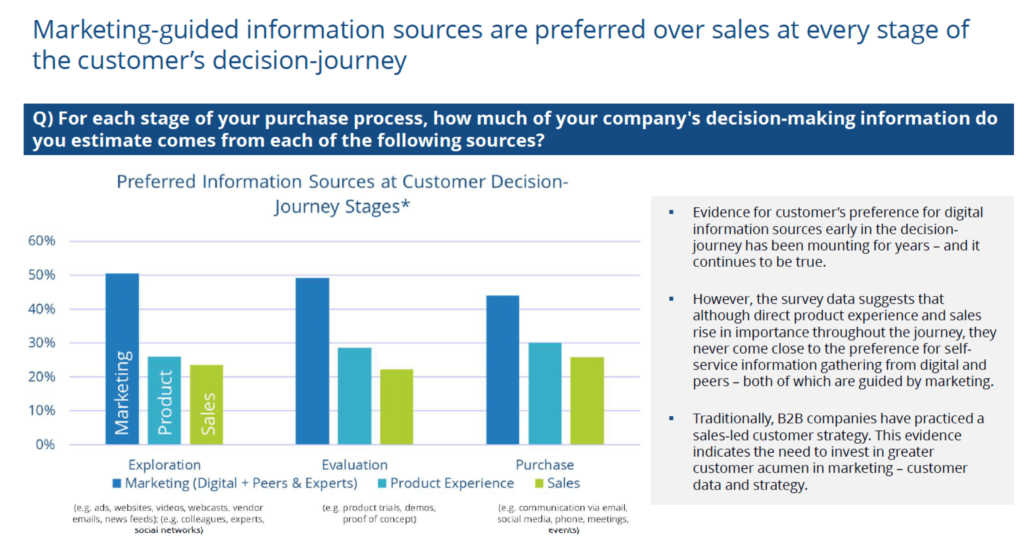
Covid-19 meant that all sales channels moved online overnight. To continue trading, marketing teams were forced to respond. A recent IDC survey, identifies growth in self-serve content at both the exploration phase and post-purchase phases of the buying cycle. But the biggest growth is in the evaluation and purchase phases. This highlights the need for marketing teams to support the customer journey at every step – from left to right.
A major challenge for marketers in 2020 and now (post-pandemic) is how to create great self-serve content that supports the moment of purchase. This stage is usually associated with face-to-face meetings, conferences and events. We’re seeing more live demos on Teams or Zoom and interactive Q&A sessions, but the mission continues to develop creative and interesting new formats.
This new, ever-evolving style of online content is part of the ‘new normal’ for marketing. Self-serve content is here to stay and is worthy of focus and investment. The diagram below shows that the customer preference is for digital content at every stage in the customer buying journey.
Marketing teams must make virtual events a priority
Packed exhibition halls, shaking hands at expos – it seems like a distant memory. With large-scale live events currently on hold, could they become a thing past? Perhaps. Aside from the obvious risks associated with spreading Covid-19, events are expensive to exhibit at too. Floor space, stands, logistics, staff costs – you need to generate lots of leads to get solid ROI when exhibiting. With this in mind, it’s understandable why virtual exhibitions are welcomed. With no geographical or financial barriers, digital events are also more accessible.
But there are some things to consider
Reimagine don’t replicate
We must reimagine or rethink events, not replicate past formats and ‘shoehorn’ live events into a digital space. “Walking” a virtual exhibition floor isn’t a substitute for the real life experience. But there are opportunities to try different approaches that work well in a digital format. Gamification is a good example, and it’s a great way to drive audience engagement. Some virtual event platforms can set up virtual booths, where event visitors can play games and win prizes.
One to few – not few to many
The great thing about virtual events is that they can be tailored for your audience. In comparison to large live events where this isn’t possible. Chat functions, breakout rooms and one-to-one meetings open up new possibilities. In particular, at B2B events networking is a priority for visitors. Thankfully, digital functions accommodate networking well. Additionally, when travelling isn’t an issue – we can all be more flexible.
We’re not insisting that large live events won’t happen. But re-imagined events are generating huge online engagements and really driving sales. So, we believe everyone will think twice before assuming a live event is the best solution and investment and will initially default to online formats. Even in the case of smaller corporate hospitality events, we’re sure to see more virtual escape rooms, cheese and wine evenings and fewer corporate golf days.
The big Martech bang
In 2008 we saw an explosion of marketing technology (MarTech) solutions launch. The recession meant that marketing budgets were limited. The MarTech tools allowed businesses to run their own marketing campaigns, outsourcing less. Typical MarTech applications included – automation, social media management and web/SEO
But, as the digitalisation of society continued marketing on the internet naturally became more complex. Because of this, in-house marketing departments were seeing skills gaps. Some aspects of marketing were now increasingly technical and specialised.
Back to 2021 and the pace of new MarTech products launching has slowed. We’re not seeing as many new solutions appear. Instead, technology is evolving in the features and functionality of existing products.
What has COVID-19 changed for good in the world of digital marketing?
The truth is, no one is 100 per cent sure, and that uncertainty can bring anxiety. But one thing is absolutely certain – it’s never dull in the world of marketing.
And finally, if for some strange reason you haven’t seen The Wizard of Oz, you really should! Here’s a link – https://play.google.com/store/movies/details?id=3AvfOFVudUc
Source: McKinsey – How Covid is changing consumer behaviour – June